Urban Hive
29 Sep 2026 14:43
Company / Designer
Ted Mannix
What is it?
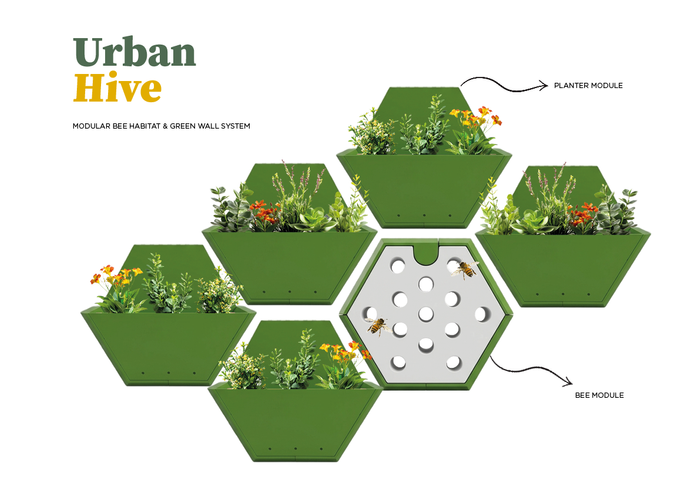
Urban Hive is a modular bee habitat and green wall system designed to support solitary bees while bringing more planting and biodiversity into urban spaces. The system combines two hexagonal components: a Bee Module, providing nesting spaces for solitary bees, and Planter Modules, providing nearby flowers and plants as a food source.
Designed to work in spaces ranging from gardens and balconies to schools, offices and public buildings, the modules can be arranged together to create a green wall suited to the available space.
Why is it a Green Hero?
Urban Hive responds to two connected challenges: the loss of suitable habitats for solitary bees and the decline of green space within increasingly urban environments.
Unlike a conventional bee hotel, the system considers both nesting habitat and access to food. The Bee Module uses spaced nesting openings designed to reduce overcrowding, while adjoining Planter Modules can be filled with bee-friendly plants, helping provide forage close to the nesting site.
Material choices have also been considered as part of the design. The proposed system uses recycled HDPE, a bio-resin composite incorporating recycled paper cups, and coconut fibre for the nesting material.
Technology adds another layer to the idea. A sensor within the Bee Module is designed to detect bee activity and connect to a mobile app, helping users monitor their habitat while receiving information and maintenance reminders.
The Story Behind It
Urban Hive was developed by industrial designer Ted Mannix, whose interest in creating green spaces began after seeing a bee brick at the London Design Festival. His research led him to question whether existing products were doing enough to meet the actual nesting and foraging requirements of solitary bees.
What began as an attempt to rethink the bee brick developed into a wider modular system designed around both bees and people. The concept evolved from a built-in product into an easy-to-install wall-mounted system, with separate habitat and planting modules and an accompanying app.
Ted studied Industrial Design at Brunel University, where his work developed around CAD, prototyping, manufacturing and hands-on product development. His growing interest in sustainability has led him to explore how industrial design can create solutions that benefit both people and the environment.